Bhopal is both a city and a word. For industrial chemistry, it became shorthand for what happens when an extremely reactive substance meets a safety system that has been switched off. In a matter of hours, a single tank turned a compound used to make insecticide into one of the greatest catastrophes ever caused by human hands.
This article reconstructs what happened, explains the chemistry of methyl isocyanate — the gas responsible for the tragedy — describes the failures that made the disaster possible, and follows what came after: the victims, the humanitarian response (including the visit of Mother Teresa, who left Calcutta to comfort the survivors), the legal battles, and the lessons that forever changed how the world handles dangerous factories.
§ 01 What the Bhopal disaster was
Bhopal is the capital of the state of Madhya Pradesh, in central India. In the 1970s, Union Carbide India Limited (UCIL), a subsidiary of the American Union Carbide Corporation, built a plant there to produce carbaryl (sold under the Sevin brand), an insecticide widely used in agriculture.
To manufacture carbaryl, the plant produced and stored large quantities of methyl isocyanate (MIC), an extraordinarily toxic and reactive chemical intermediate. On the night of the accident, the underground tank labelled E610 held about 42 tonnes of liquid MIC.
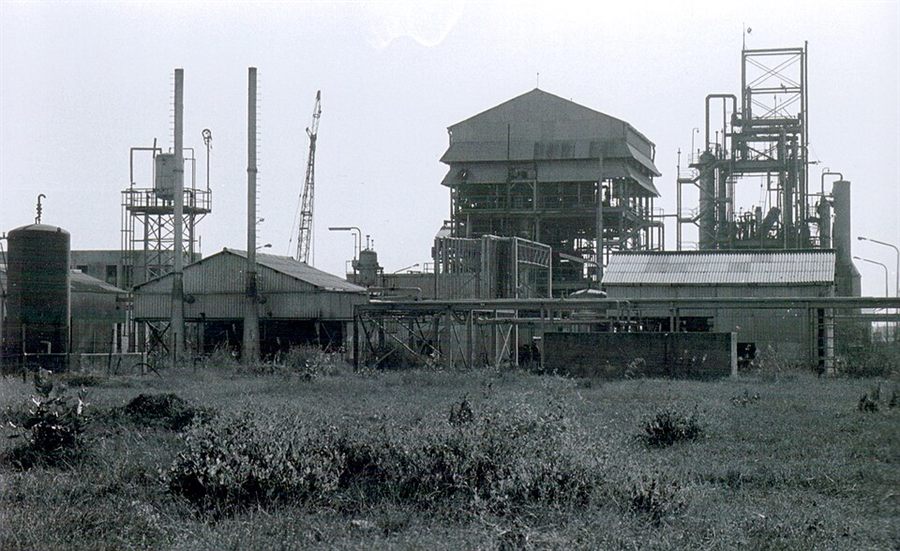
Around midnight, water ended up entering that tank. The contact triggered a violent, exothermic chemical reaction: temperature and pressure soared, the relief valves opened, and a cloud of gas — estimated at 30 to 40 tonnes of MIC, along with other decomposition products — leaked into the atmosphere. Denser than air, the cloud sank and spread close to the ground, right over the poorest and most densely populated neighbourhoods surrounding the plant.
§ 02 The chemistry: what methyl isocyanate is
Methyl isocyanate has the molecular formula C₂H₃NO and the structure CH₃–N=C=O. It is a colourless, volatile liquid with a pungent smell, belonging to the family of isocyanates — compounds that contain the reactive functional group –N=C=O.
Methyl isocyanate (MIC)
Three properties explain why it is so dangerous:
- Reactivity with water. MIC reacts with water exothermically (releasing heat), forming carbon dioxide and methylamine, among other products. When there is a lot of water and the heat is not removed, the reaction accelerates on its own — a runaway reaction.
- Volatility. With a boiling point of about 39 °C, only a small amount of heating is needed for the liquid to turn rapidly into vapour.
- Toxicity. Even at very low concentrations, MIC attacks the eyes, the airways and the lungs.
In a simplified form, the reaction that started the tragedy can be written like this:
The heat released vaporised more MIC and raised the internal pressure. As we will see, the refrigeration system that should have kept the tank cold was switched off, and the equipment designed to neutralise or burn off the gas before it escaped did not work.
§ 03 The night of 2–3 December 1984
Accounts converge on an approximate sequence of events. Around 9–10 pm on 2 December, workers noticed leaks and the characteristic smell of MIC. Shortly after midnight, the pressure in tank E610 rose alarmingly. The reaction was already running away.
Between 12:30 and 1 am, the safety valves gave way and the gas began escaping through the relief stack. The cloud drifted with the wind over neighbourhoods such as Jai Prakash Nagar and Kazi Camp, and toward the busy Bhopal railway station. Thousands of people woke up choking, eyes burning, coughing blood. Many died at home or while fleeing; others were trampled in the panic.
"It was like breathing fire. People ran without knowing where to go, falling along the way." — A recurring account from Bhopal survivors
§ 04 The victims and the health effects
Bhopal's numbers are still disputed today — partly because many victims were informal residents with no records, and partly because of the deaths that followed over the years.
- Immediate estimates speak of thousands dead in the first hours and days — early official figures hover around 2,000 to 4,000, but independent surveys suggest that roughly 8,000 people died within the first two weeks.
- Over the following decades, the total number of deaths linked to the exposure is estimated to have reached 15,000 to 20,000.
- More than half a million people were exposed to the gas. Many survived with permanent damage.
Health effects included severe eye injuries (including blindness), pulmonary oedema, chronic respiratory damage, neurological problems and reproductive impacts. Later studies also associated exposure with birth defects in babies born in the region.
§ 05 Mother Teresa in Bhopal
A few days after the disaster, in December 1984, Mother Teresa — by then a Nobel Peace laureate and one of the most recognisable humanitarian figures alive — left Calcutta, the city where she had founded the Missionaries of Charity, and travelled to Bhopal to be with the survivors. She brought sisters from her congregation, who joined the relief effort in the overwhelmed hospitals and improvised camps where thousands of half-blinded, breathless people were still arriving.
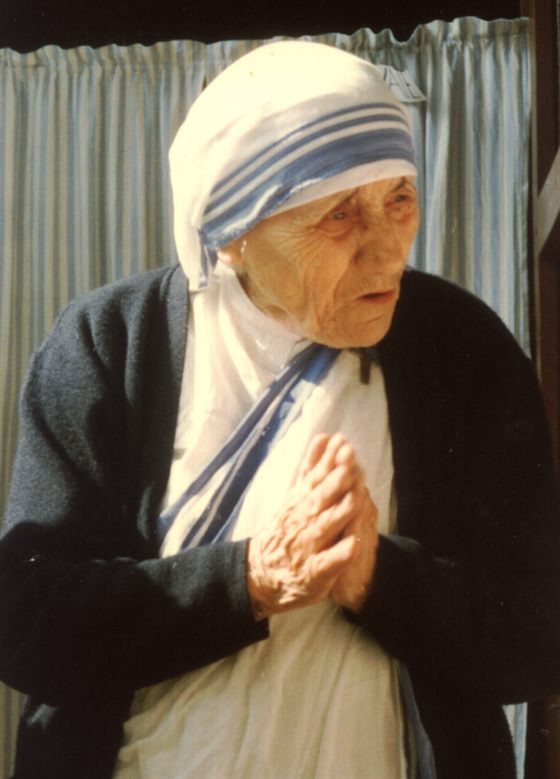
What she did in Bhopal was, above all, presence: she toured the worst-hit neighbourhoods, visited the injured, and set her sisters to work caring for the dying and the orphaned. She handed out small aluminium medallions and repeated a single message — "forgive, forgive." Her arrival drew the world's press to the slums around the plant, and for a moment the suffering of Bhopal's poorest residents became front-page news everywhere.
But that same message exposed the deepest wound of the story — the injustice. To survivors who had lost children, their eyesight or their lungs, a call to forgive felt premature, even misplaced: forgive whom, and in exchange for what? No executive had been held to account; no adequate compensation had been paid. The victims were overwhelmingly the urban poor who lived pressed against the factory fence — people with no records, no savings and little political voice. Charity could comfort them, but it could not give them justice, clean water, or a defendant in the dock.
That tension runs through the whole tragedy: on one side, an outpouring of compassion; on the other, the long, grinding, still-unfinished search for accountability — the subject of the next sections. Bhopal is remembered not only as a chemical catastrophe but as a textbook case of how disaster falls hardest on those least able to bear it.
§ 06 The causes: why safety failed
Bhopal was not a "natural" accident. Investigations and lawsuits exposed a chain of failures that had built up over months:
- Refrigeration system switched off. The MIC tank was supposed to be kept refrigerated to reduce reactivity. The refrigeration unit had been shut down to save costs.
- Gas scrubber inoperative. The equipment meant to neutralise the gas with caustic soda was under maintenance or set far below the needed capacity.
- Flare tower out of service. The tower that should have incinerated escaping gas was disabled for repair.
- Understaffing and poor training. Cost cuts reduced staff and maintenance; alarms and procedures were neglected.
- Excess storage. Keeping dozens of tonnes of such a dangerous intermediate in stock hugely magnified the scale of the leak.
In other words: every safety barrier that could have contained or reduced the leak was absent at the same time. In safety engineering, this is the so-called "alignment of the Swiss-cheese holes" — when several independent failures overlap and open a clear path to disaster.
§ 07 Justice, compensation and legal legacy
The legal aftermath dragged on for decades and left a widespread sense of incomplete justice:
- In 1989, Union Carbide reached a settlement with the Indian government worth US$ 470 million — a sum many considered low given the scale of the harm.
- Warren Anderson, then chairman of Union Carbide, was charged by the Indian courts but was never extradited; he died in 2014 without answering the case in India.
- In 2010, an Indian court convicted seven former UCIL executives of negligence, with sentences widely seen as lenient.
- In 2001, Dow Chemical acquired Union Carbide, and the dispute over responsibility for cleaning up the site extended to the new owner.
§ 08 The contamination that never left
Bhopal's drama did not end in the 1980s. The grounds of the old plant were never fully decontaminated. Toxic waste abandoned on site contaminated the soil and the groundwater, affecting the water consumed by neighbouring communities for many years. Generations born after 1984 went on living with the effects of the disaster, making Bhopal also an emblematic case of environmental injustice.
§ 09 What the world learned
As tragic as it was, Bhopal transformed chemical safety across the entire planet:
- In the United States, it led to the passage of the Emergency Planning and Community Right-to-Know Act (1986), which requires industries to disclose which hazardous substances they store and to plan emergency responses together with their communities.
- The chemical industry adopted voluntary programmes such as Responsible Care, focused on transparency and process safety.
- It cemented the principle of "safer chemistry by design": reducing stockpiles of dangerous intermediates, producing on demand, and preferring routes that avoid extremely reactive compounds whenever possible.
- It reinforced the idea that safety is not a cost to be cut, but an inseparable part of operating any chemical plant.
How another Bhopal can be prevented — the chemistry
The lasting lessons are not only legal and organisational; they are chemical. Bhopal happened because a large mass of an extremely reactive intermediate was stored, warm and badly guarded, next to the very substance — water — that sets off its runaway hydrolysis. Modern process safety attacks exactly those chemical facts:
- Don't store the hazard — design it out. The single most important idea is inherently safer design: make methyl isocyanate only in tiny amounts and consume it immediately in the next reaction, instead of holding tonnes in a tank. After Bhopal, carbaryl producers moved toward routes that never isolate bulk MIC (for example, reacting the components in sequence so MIC exists only fleetingly). The smaller the inventory, the smaller the worst possible release.
- Control the kinetics — keep it cold. The MIC + water reaction is exothermic, so the heat it releases accelerates it further. Refrigerating the tank slows that chemistry to a crawl; the Bhopal refrigeration unit had been switched off, removing the brake that keeps a runaway from starting.
- Keep incompatible substances apart. The trigger was water entering tank E610. Rigorous isolation of reactive chemicals from water, acids and metal contaminants (which also catalyse MIC's decomposition) is now a core design rule.
- Working chemical safeguards. A caustic-soda (NaOH) scrubber neutralises escaping isocyanate, and a flare tower burns it to less harmful gases before it reaches the air. These only protect a city if they are switched on, maintained and sized for the worst case — at Bhopal, none of them were.
§ Sources References and further reading
- International Medical Commission on Bhopal — reports on the health effects of MIC exposure.
- Eckerman, I. The Bhopal Saga: Causes and Consequences of the World's Largest Industrial Disaster.
- U.S. Chemical Safety Board / EPA — materials on methyl isocyanate and the Emergency Planning and Community Right-to-Know Act (EPCRA, 1986).
- Historical coverage and archives of Mother Teresa's visit to Bhopal in December 1984.
Victim figures vary between official and independent sources; this article presents the ranges most often cited in the literature.