Hang it in any chemistry classroom in the world and it is recognised instantly: that colourful block of little squares, each with a letter and a number. The Periodic Table is far more than a poster. It is a system that organises everything matter is made of — and that predicts the behaviour of elements you have never seen, just from the position they occupy.
In this article you will understand what the Periodic Table is, how to read its rows and columns, what the blocks and families of elements are, the fascinating history behind its creation, and the periodic trends that explain why it works so well.
§ 01 What the Periodic Table is
The Periodic Table is the standard way of organising the chemical elements — the simplest substances, made of a single type of atom, such as hydrogen, oxygen or gold. Each element occupies a cell with its symbol (for example, O for oxygen), its atomic number (the number of protons in the nucleus) and its atomic mass.
The secret is in the order. The elements are laid out in increasing order of atomic number, from left to right and top to bottom. But the arrangement is not a simple queue: it is "folded" into rows and columns so that elements with similar chemical behaviour fall exactly beneath one another. That is where the name comes from: the properties repeat periodically.
§ 02 Periods and groups: how to read the table
Two directions structure the whole table:
- Periods are the 7 horizontal rows. Moving across a period from left to right, we add one proton (and one electron) at a time. The period number tells you how many electron shells the atom has.
- Groups (or families) are the 18 vertical columns. Elements in the same group have the same number of valence electrons — the outermost shell — and therefore react in similar ways.
It is this simple rule — same column, same valence — that makes the table so powerful. Knowing that sodium (Na) and potassium (K) are in the same group already tells you both are very reactive metals that react violently with water.
§ 03 The s, p, d and f blocks
The table can also be divided into four blocks, which correspond to the type of orbital where the atom's last electron fits:
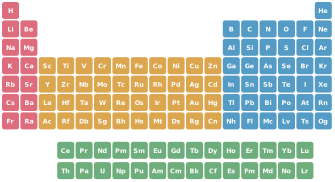
- s-block — the first two columns (alkali and alkaline-earth metals), plus hydrogen and helium.
- p-block — the six columns on the right, home to the non-metals, the metalloids and the noble gases.
- d-block — the transition metals, in the centre of the table (iron, copper, gold…).
- f-block — the lanthanides and actinides, usually drawn as two separate rows below the table so it doesn't become too wide.
§ 04 The main families of elements
Some groups are so distinctive that they have their own names:
- Alkali metals (group 1): very reactive, soft, react with water.
- Alkaline-earth metals (group 2): reactive, but less so than the alkalis (calcium, magnesium).
- Transition metals (groups 3 to 12): tough, good conductors, form coloured compounds (iron, copper, zinc).
- Halogens (group 17): very reactive non-metals that form salts (fluorine, chlorine, iodine).
- Noble gases (group 18): almost inert, because they already have a complete valence shell (helium, neon, argon).
- Lanthanides and actinides: f-block elements; among the actinides are uranium and plutonium.
§ 05 A brief history
The table was not born complete. It is the result of decades of attempts to organise the chaos of the known elements:
- 1829 — Döbereiner's triads. The German chemist Johann Döbereiner noticed groups of three elements with related properties.
- 1864 — Newlands' octaves. John Newlands observed that, every eight elements ordered by mass, the properties seemed to repeat, like musical notes.
- 1869 — Mendeleev. The Russian Dmitri Mendeleev published the table we know. His stroke of genius was to leave gaps for elements not yet discovered and to predict their properties. When gallium and germanium were found, they fit the predictions almost perfectly — which made the table famous.
- 1913 — Moseley. The British physicist Henry Moseley showed that the correct ordering criterion was not mass but atomic number. This corrected a few inversions and gave the table its definitive basis.
- 20th century — Seaborg. Glenn Seaborg reorganised the bottom of the table by positioning the actinide series, paving the way for the heavy synthetic elements.
§ 06 Why the table works
The great revelation of the 20th century was understanding that periodicity comes from the electron configuration of atoms. Electrons organise into shells and subshells (orbitals), and it is the outermost shell that determines how an element reacts.
Because the valence electrons repeat in predictable patterns as the atomic number increases, the chemical properties repeat too. The table, then, is not an arbitrary convention: it is a portrait of the electronic structure of atoms.
§ 07 The periodic trends
Because of this structure, several properties vary in a regular way across the table. The four most important:
- Atomic radius — the "size" of the atom. Generally decreases across a period (left to right) and increases going down a group.
- Ionisation energy — the energy needed to remove an electron. Increases across a period and decreases down a group.
- Electronegativity — an atom's tendency to attract electrons in a bond. Grows toward fluorine, in the top-right corner.
- Electron affinity — the energy released when an atom gains an electron.
§ 08 How to use the Periodic Table today
In practice, the table is a visual calculator. With it you can tell, at a glance:
- whether an element is a metal, non-metal or metalloid;
- how reactive it is and what kind of bond it tends to form;
- the atomic mass for calculating molar masses;
- how properties compare between neighbouring elements.
Explore the interactive periodic table on Atomurus to click any element and see its full data, or use the Compare tool to place two elements side by side.
§ 09 Metals, non-metals and metalloids
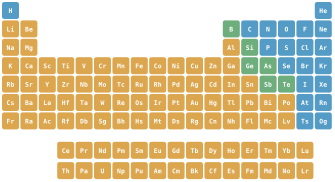
Beyond blocks and families, the table splits the elements into three great classes, separated by a famous "staircase" line that runs down the right-hand side:
- Metals — the vast majority (everything to the left of the staircase). They are shiny, conduct heat and electricity, are malleable and ductile, and tend to lose electrons to form positive ions (cations).
- Non-metals — the top-right corner (plus hydrogen). They are poor conductors, often gases or brittle solids, and tend to gain or share electrons to form negative ions (anions) or covalent bonds.
- Metalloids — the narrow diagonal band along the staircase (boron, silicon, germanium, arsenic, antimony, tellurium). They sit in between, with mixed properties — silicon, for instance, is the semiconductor at the heart of every computer chip.
§ 10 How to read a single element cell
Every cell packs four key pieces of information into a tiny square. Once you can read one, you can read all 118:
The atomic number (Z) is the identity card: it is the number of protons, and it never changes for a given element. The atomic mass, just below the symbol, is the weighted average mass of the element's natural isotopes — which is why it is rarely a whole number.
§ 11 The frontier: synthetic elements
Not all elements occur in nature. Everything beyond uranium (Z = 92) is essentially synthetic — forged in nuclear reactors or particle accelerators by smashing lighter nuclei together. These superheavy elements, which complete period 7 up to oganesson (Z = 118), are intensely radioactive and often survive for only fractions of a second before decaying.
Because they vanish so fast, some have only ever existed as a handful of atoms. That raises a natural question: is there a limit? Physicists hypothesise an "island of stability" — a cluster of yet-undiscovered superheavy elements whose particular numbers of protons and neutrons might make them far longer-lived than their neighbours. Searching for it is one of the frontiers of modern chemistry, and the reason the table may still grow.
§ 12 Frequently asked questions
Why is hydrogen sometimes placed on its own?
Hydrogen has a single electron, like the group-1 alkali metals, so it usually sits at the top of group 1. But it is a non-metal and behaves very differently from sodium or potassium, so some tables float it above the centre to show it doesn't truly belong to any family.
Why are there exactly 18 groups?
The number of columns reflects how many electrons fit in the outer sub-shells as they fill: 2 in the s sub-shell and 6 in the p sub-shell give the 8 main-group columns, and the 10 transition-metal columns come from the d sub-shell (2 + 6 + 10 = 18).
What is the most electronegative element?
Fluorine, in the top-right of the reactive non-metals, is the most electronegative element — it pulls bonding electrons toward itself more strongly than any other atom.
Why are the lanthanides and actinides printed below the table?
They belong in the f-block, between groups 2 and 3 of periods 6 and 7. Drawn in place, they would make the table about 32 columns wide; pulling them out keeps it compact and readable.
§ Sources References and further reading
- IUPAC — Periodic Table of the Elements (official version and nomenclature).
- Scerri, E. The Periodic Table: Its Story and Its Significance.
- Mendeleev, D. — original 1869 work on the periodic classification of the elements.
- Moseley, H. (1913) — on atomic number as the ordering criterion.